Cloud PointField Guide

Supplementary feature

Mammatus

The sky's hanging pouches

Written by Laurence WayneEntry No. 2Rare

Mammatus: The sky's hanging pouches
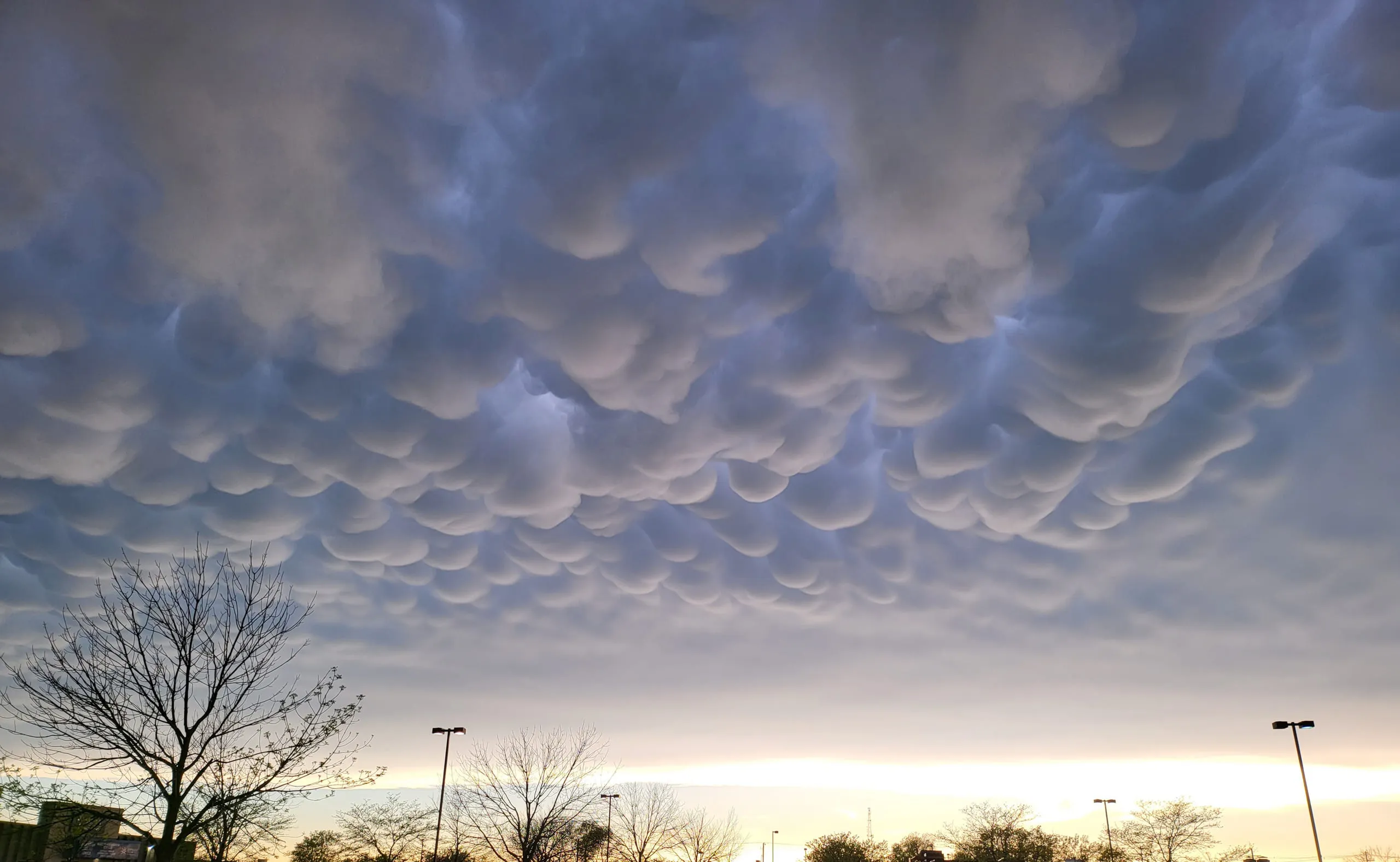
Plate IIPhotograph by Sasaanfafaan, CC BY-SA 4.0.

Mammatus are eye-catching, pouch-like lobes that hang from the underside of a cloud — most often the anvil of a cumulonimbus after a storm. Unlike most clouds, which form in rising air, mammatus form where pockets of cloudy, cooler air sink into clearer air below. Their dramatic, sometimes ominous appearance often catches the light beautifully at sunset.

Worth knowing

  • Mammatus can hang from clouds for 10-15 minutes before dissipating.
  • Each 'lobe' can be 1-3 km across and extend about 0.5 km downward.
  • They're most dramatic when lit by the setting Sun, often appearing orange or pink.
  • The exact formation mechanism is still debated by scientists - several theories exist!
Note

Still unsure it's the same cloud? Our app, Cloud Point— on iOS and Android — reads a photo and returns the likely type with altitude, useful when a formation is fading faster than you can look it up.
Test yourselfThree levels

Choose a difficulty

Where would you most often look to spot mammatus clouds?

  1. aHanging beneath the anvil of a thunderstorm cloud
  2. bRolling along the ground as fog
  3. cHigh up as thin, icy streaks
  4. dForming a smooth lens over a mountain
Show answer

AnswerHanging beneath the anvil of a thunderstorm cloud

Mammatus most often hang in pouches from the underside of a cumulonimbus anvil, and are frequently seen after a thunderstorm has passed.

What makes mammatus clouds unusual compared with most other clouds?

  1. aThey are made of sand rather than water
  2. bThey form from sinking air rather than rising air
  3. cThey only appear at the North Pole
  4. dThey glow in the dark
Show answer

AnswerThey form from sinking air rather than rising air

Most clouds form in rising, cooling air. Mammatus are the opposite: their distinctive pouches are sculpted by pockets of cool, cloudy air sinking into drier air below.

Mammatus lobes hang beneath a cloud, with the air inside them sinking. What makes that cloudy air sink?

  1. aWarm, buoyant air rising up into the anvil
  2. bSublimating ice and evaporating droplets chill the air, making it denser than its surroundings so it sinks
  3. cThe sheer weight of accumulated hailstones dragging the base down
  4. dDownward pressure waves from the thunder
Show answer

AnswerSublimating ice and evaporating droplets chill the air, making it denser than its surroundings so it sinks

As ice sublimates and droplets evaporate at the cloud base, the air cools, becomes denser than the clear air below and sinks into the rounded mammatus lobes.

Nearby in the guide