Cloud PointField Guide

Optical phenomenon — perspective

Anticrepuscular Rays

Sunbeams converging opposite the sun

Written by Laurence WayneEntry No. 37Uncommon

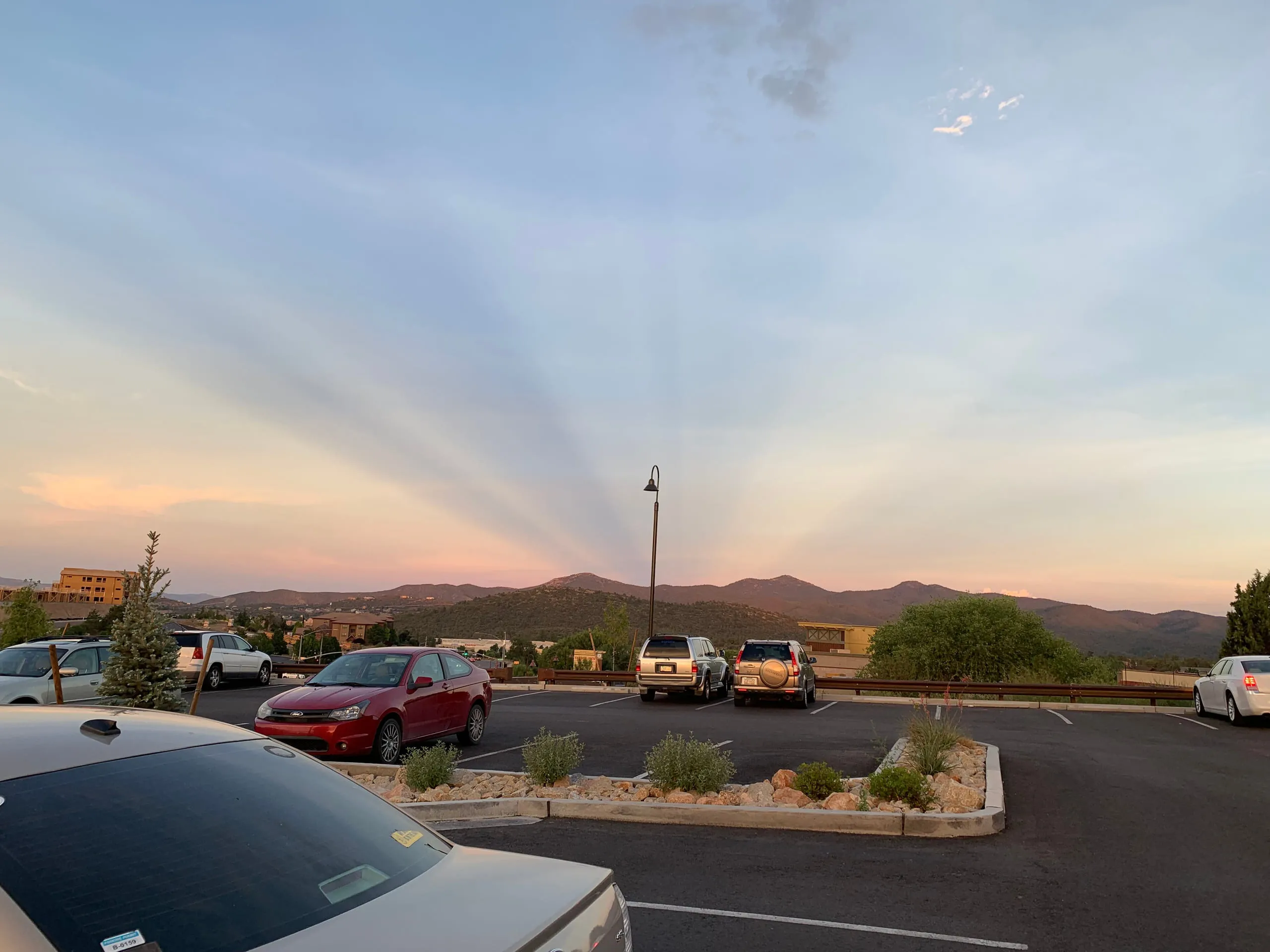
Anticrepuscular Rays: Sunbeams converging opposite the sun
Plate XXXVIIPhotograph by Gaurav, CC BY 4.0.

Anticrepuscular rays are alternating bright beams and darker shadow bands that appear to converge on the antisolar point — the spot on the horizon directly opposite the sun. They are the very same shafts of sunlight and cloud shadow as ordinary crepuscular rays; in reality the beams are nearly parallel, but perspective makes them seem to meet, just as parallel railway tracks appear to converge at a vanishing point.

Worth knowing

  • Anticrepuscular rays are always dimmer than the crepuscular rays near the sun, because they rely on light scattered back towards you — and back-scattering is far weaker than the forward-scattering that lights up beams on the sun's side of the sky.
Note

Still unsure it's the same cloud? Our app, Cloud Point— on iOS and Android — reads a photo and returns the likely type with altitude, useful when a formation is fading faster than you can look it up.
Test yourselfThree levels

Choose a difficulty

Where in the sky do you look to see anticrepuscular rays?

  1. aStraight at the sun
  2. bThe point on the horizon directly opposite the sun
  3. cOnly at the very top of the sky
  4. dUnderneath a rainbow
Show answer

AnswerThe point on the horizon directly opposite the sun

They appear to converge on the antisolar point, directly opposite the sun.

The rays seem to converge to a point. Are they really converging?

  1. aYes — real beams meeting in the sky
  2. bNo — they are essentially parallel and only appear to converge by perspective
  3. cYes — they are bent by Earth's magnetic field
  4. dNo — they are reflections off water
Show answer

AnswerNo — they are essentially parallel and only appear to converge by perspective

Like railway tracks meeting at a vanishing point, the convergence is a perspective illusion.

Why are anticrepuscular rays usually fainter than crepuscular rays?

  1. aThe sun is weaker at that hour
  2. bBack-scattering of light towards the observer is weaker than forward-scattering
  3. cClouds absorb most of the light
  4. dThey are seen through more ozone
Show answer

AnswerBack-scattering of light towards the observer is weaker than forward-scattering

Anticrepuscular rays depend on back-scattered light, which is less efficient than the forward scattering near the sun.

Nearby in the guide