Cloud PointField Guide

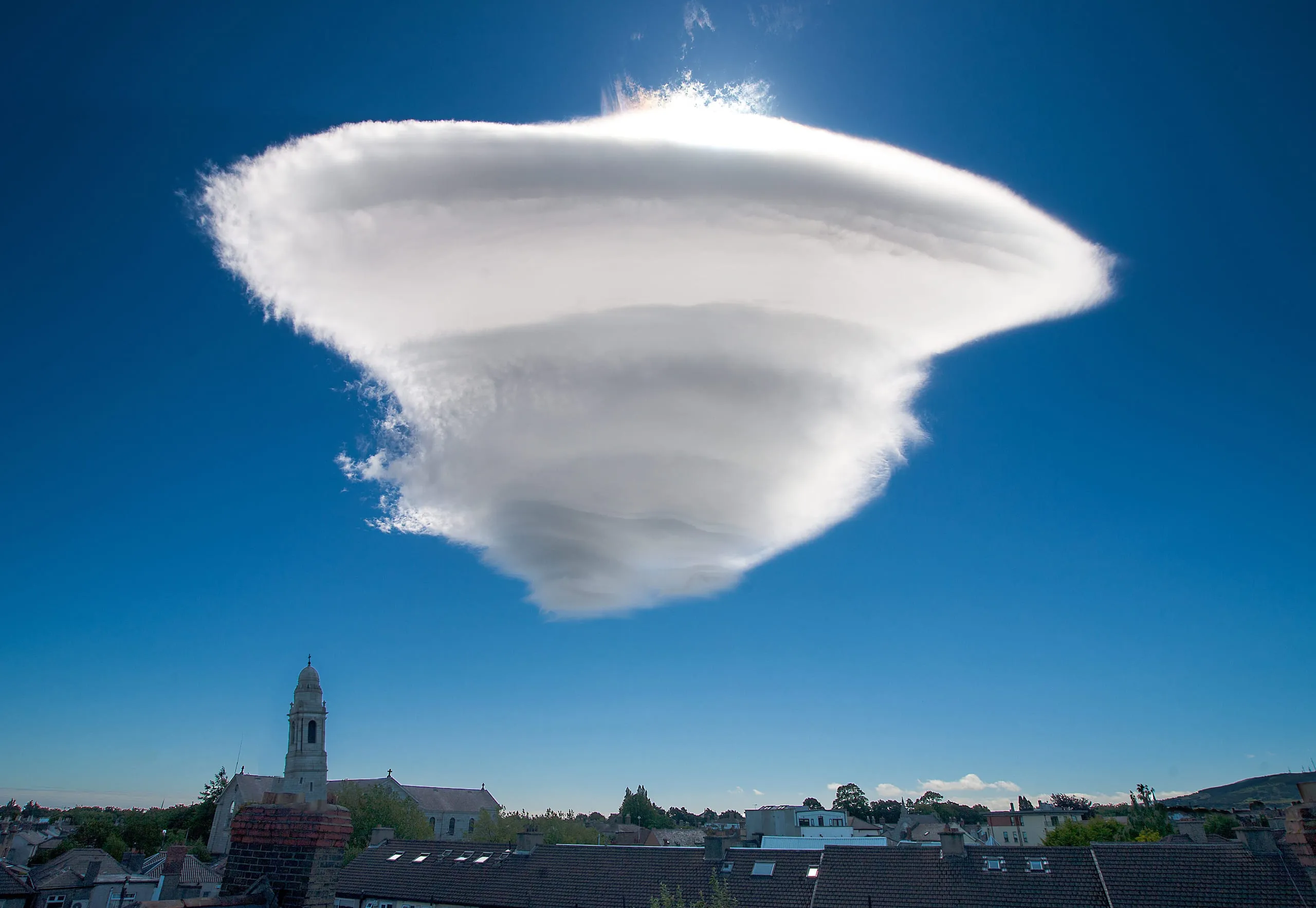
Special cloud (Altocumulus lenticularis)

Lenticular

The 'flying saucer' of the sky

Written by Laurence WayneEntry No. 25Uncommon

Lenticular: The 'flying saucer' of the sky
Plate XXVPhotograph by Omnisource5, CC BY-SA 4.0.

Smooth, lens- or saucer-shaped clouds that hover, seemingly motionless, near hills and mountains. They form when moist air is forced up and over high ground, creating standing waves downwind. Air condenses into cloud at the crest of each wave and evaporates again as it descends, so the cloud stays fixed in place even as the wind rushes through it.

Worth knowing

  • Lenticular clouds are so often mistaken for UFOs that they are one of the most common natural explanations for 'flying saucer' sightings — they hang stationary, have a sharp lens shape, and can stack like a pile of plates.
Note

Still unsure it's the same cloud? Our app, Cloud Point— on iOS and Android — reads a photo and returns the likely type with altitude, useful when a formation is fading faster than you can look it up.
Test yourselfThree levels

Choose a difficulty

Lenticular clouds are so smooth and saucer-shaped that they are often mistaken for what?

  1. aUFOs or 'flying saucers'
  2. bSmoke from a fire
  3. cA rainbow
  4. dThe Moon
Show answer

AnswerUFOs or 'flying saucers'

Their sharp, stacked, lens-like shape and the way they hang motionless make lenticular clouds one of the most common natural explanations for 'flying saucer' sightings.

Why does a lenticular cloud appear to stay still even in strong wind?

  1. aIt is frozen onto the mountain top
  2. bThe wind never actually moves at that altitude
  3. cCloud constantly forms at a wave crest and evaporates as air descends, holding its shape in place
  4. dIt is much heavier than other clouds
Show answer

AnswerCloud constantly forms at a wave crest and evaporates as air descends, holding its shape in place

Air rises and condenses at the crest of a mountain wave, then sinks and evaporates on the far side. The cloud marks the wave, not the air, so it appears stationary while wind flows through it.

A lenticular cloud can hang motionless for hours in a strong wind. How?

  1. aThe wind stops completely inside the wave
  2. bAir flows straight through it — droplets condense on the upwind side and evaporate on the downwind side, so the cloud stays put while the air moves
  3. cIt is physically anchored to the mountain by its base
  4. dIt is simply too heavy to be blown along
Show answer

AnswerAir flows straight through it — droplets condense on the upwind side and evaporate on the downwind side, so the cloud stays put while the air moves

In a standing mountain wave the air keeps moving through the cloud: vapour condenses as it rises on the windward side of the crest and evaporates as it sinks on the lee side, holding the cloud in place.

Nearby in the guide