Cloud PointField Guide

Optical phenomenon — refraction

Rainbow

Sunlight unravelled by falling raindrops

Written by Laurence WayneEntry No. 12Common

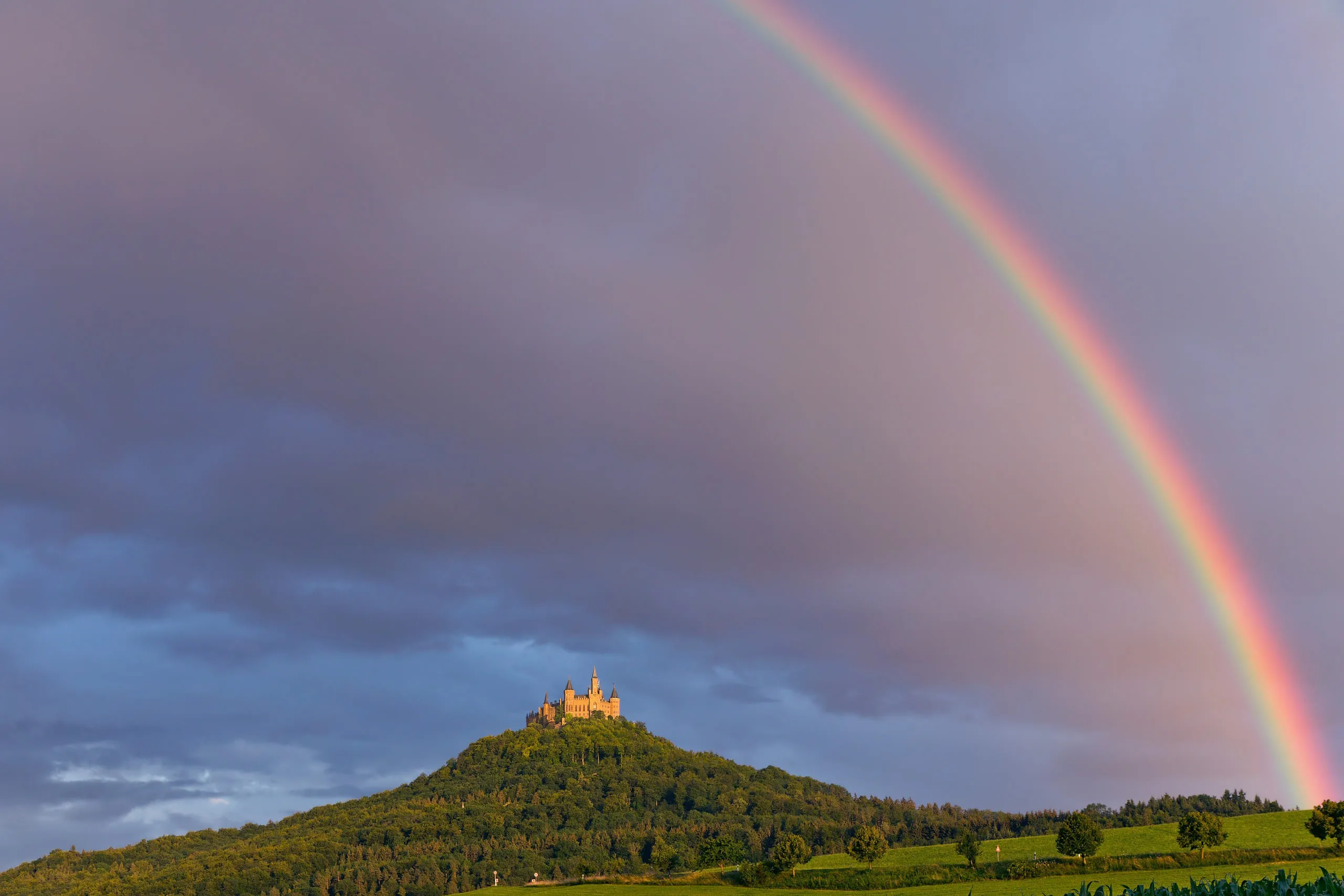
Rainbow: Sunlight unravelled by falling raindrops
Plate XIIPhotograph by Sven Teschke, CC BY-SA 3.0 DE.

A rainbow appears when sunlight shines into falling rain from behind you: each raindrop bends the light, bounces it off its back, and splits it into its colours. The light gathers into an arc about 42° from the point directly opposite the sun, with red on the outside and violet on the inside. When a fainter second bow appears outside the first, its colours run the other way.

Worth knowing

  • A second, fainter rainbow is always there alongside a bright one — sitting at about 51° — but it looks dim because far fewer light rays survive the two internal bounces inside each drop that create it. Between the two bows lies a darker strip called Alexander's band.
Note

Still unsure it's the same cloud? Our app, Cloud Point— on iOS and Android — reads a photo and returns the likely type with altitude, useful when a formation is fading faster than you can look it up.
Test yourselfThree levels

Choose a difficulty

In a normal (primary) rainbow, which colour is on the outer edge of the arc?

  1. aRed
  2. bViolet
  3. cGreen
  4. dBlue
Show answer

AnswerRed

A primary rainbow always has red on its outer edge and violet on the inner edge.

What does a single raindrop do to sunlight to help make a rainbow?

  1. aReflects it straight back like a flat mirror
  2. bRefracts it on entry, reflects it once off the back, and refracts it again on exit — splitting the colours
  3. cFreezes it into ice crystals
  4. dAbsorbs every colour but one
Show answer

AnswerRefracts it on entry, reflects it once off the back, and refracts it again on exit — splitting the colours

Sunlight refracts as it enters the drop, reflects once off the inside of the back, and refracts again as it leaves — bending and separating the colours into the arc we see at about 42°.

The sky between the primary and secondary rainbows looks noticeably darker. What is this, and why?

  1. aA cloud shadow, because the rain is thicker there
  2. bAlexander's dark band — raindrops send almost no light back to your eye at angles between the two bows
  3. cThe secondary rainbow casting its own shadow
  4. dOzone absorbing the light in that strip
Show answer

AnswerAlexander's dark band — raindrops send almost no light back to your eye at angles between the two bows

Drops scatter primary-bow light up to about 42° and secondary-bow light beyond about 51°; between those angles almost no light returns, leaving the darker Alexander's band.

Nearby in the guide