Cloud PointField Guide

Optical phenomenon — refraction

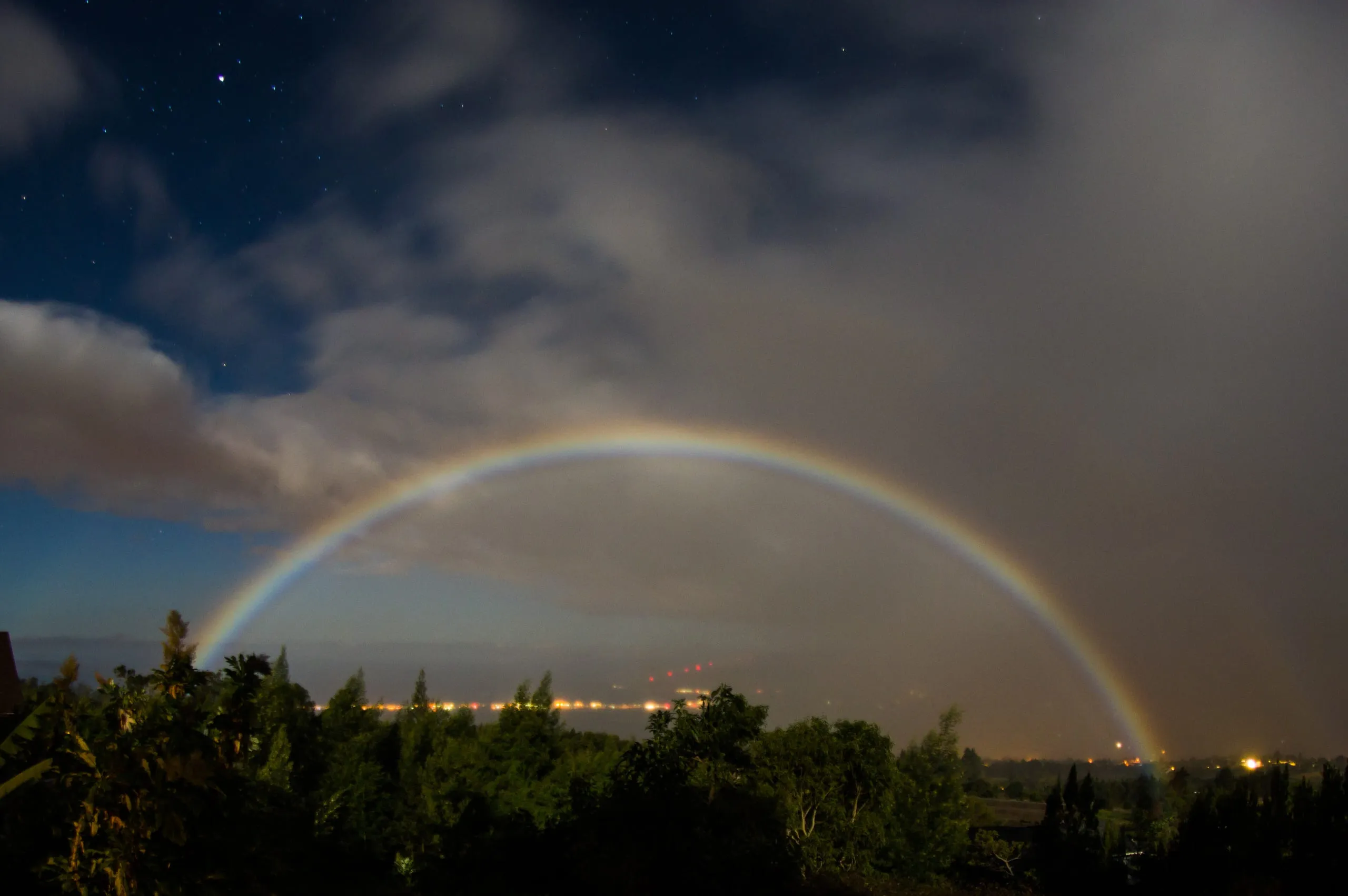
Moonbow

A rainbow made by moonlight

Written by Laurence WayneEntry No. 45Rare

Moonbow: A rainbow made by moonlight
Plate XLVPhotograph by Arne-kaiser, CC BY-SA 4.0.

A moonbow forms exactly like a daytime rainbow, but the light source is the Moon rather than the Sun. Moonlight — itself reflected sunlight — is refracted and internally reflected inside falling raindrops or waterfall spray, splitting into a spectrum and bouncing back at roughly 42° from the point opposite the Moon. Because the arc sits opposite the Moon, it is best around a bright full Moon when rain or spray hangs in the opposite part of the sky.

Worth knowing

  • A moonbow nearly always looks white or pale grey to the naked eye — not because it lacks colour, but because the light is too faint to trigger the eye's colour-sensing cone cells. A long-exposure camera gathers enough light to reveal the full rainbow spectrum the eye cannot.
Note

Still unsure it's the same cloud? Our app, Cloud Point— on iOS and Android — reads a photo and returns the likely type with altitude, useful when a formation is fading faster than you can look it up.
Test yourselfThree levels

Choose a difficulty

What lights up a moonbow?

  1. aStreetlights
  2. bThe Moon
  3. cLightning
  4. dThe stars
Show answer

AnswerThe Moon

A moonbow is a rainbow produced by moonlight instead of sunlight.

Why does a moonbow usually look white or grey rather than colourful to your eyes?

  1. aThe water droplets are too small to split colours
  2. bMoonlight contains no colours
  3. cThe light is too faint to activate the eye's colour-sensing cone cells
  4. dThe Moon only reflects green light
Show answer

AnswerThe light is too faint to activate the eye's colour-sensing cone cells

In dim light the colour-blind rod cells take over, so the arc reads as grey even though all colours are physically present.

Compared with a daytime solar rainbow, a moonbow's arc is…

  1. aMuch smaller in radius
  2. bThe same radius — about 42° — because the optics are identical and only the light source differs
  3. cA complete circle, unlike a rainbow
  4. dRoughly twice the size
Show answer

AnswerThe same radius — about 42° — because the optics are identical and only the light source differs

A moonbow forms by the same refraction and internal reflection in raindrops as a rainbow, so it shares the same ~42° radius — it is just far fainter.

Nearby in the guide