Cloud PointField Guide

Special cloud — polar stratospheric

Nacreous

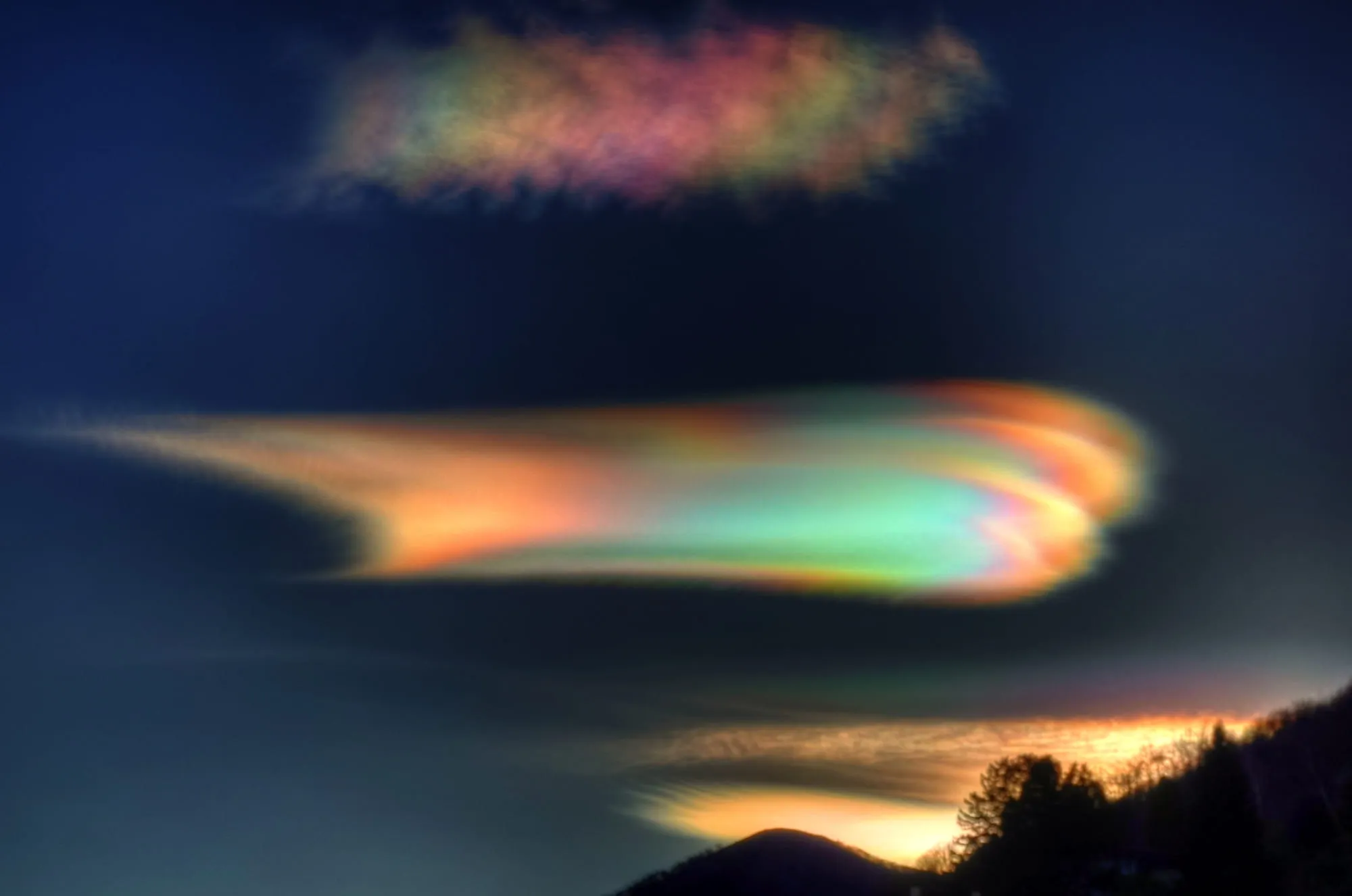
'Mother-of-pearl' clouds glowing in winter twilight

Written by Laurence WayneEntry No. 13Rare

Nacreous: 'Mother-of-pearl' clouds glowing in winter twilight
Plate XIIIPhotograph by Karin Switzerland, CC BY-SA 4.0.

Nacreous clouds — also called polar stratospheric clouds — shimmer with brilliant mother-of-pearl colours high in the winter sky near the poles. They form astonishingly high in the stratosphere, far above ordinary weather, and need temperatures below about -78°C to condense. Because they sit so high, they keep catching sunlight and glow long after the sun has set on the world below.

Worth knowing

  • Beautiful but troubling: the surfaces of these stratospheric clouds host chemical reactions that unleash ozone-destroying chlorine — they play a central role in opening the polar ozone hole.
Note

Still unsure it's the same cloud? Our app, Cloud Point— on iOS and Android — reads a photo and returns the likely type with altitude, useful when a formation is fading faster than you can look it up.
Test yourselfThree levels

Choose a difficulty

What is the most striking feature of nacreous clouds?

  1. aBrilliant iridescent 'mother-of-pearl' colours glowing in the twilight sky
  2. bA perfectly grey, featureless sheet
  3. cHeavy, dark rain clouds
  4. dA coloured ring around the sun
Show answer

AnswerBrilliant iridescent 'mother-of-pearl' colours glowing in the twilight sky

Nacreous clouds are famous for their vivid, shimmering pastel 'mother-of-pearl' colours, glowing high in the polar twilight.

What conditions do nacreous clouds need to form?

  1. aWarm, humid summer air near the ground
  2. bThe extreme cold of the polar winter stratosphere, below about -78°C
  3. cThe updraught of a thunderstorm
  4. dDust blown from a desert
Show answer

AnswerThe extreme cold of the polar winter stratosphere, below about -78°C

They form only in the bitterly cold polar winter stratosphere, where temperatures below about -78°C let the sparse moisture and acids freeze onto tiny particles.

Nacreous clouds are beautiful but have a damaging side. What is it?

  1. aThey cause acid rain at the surface
  2. bTheir surfaces drive chemical reactions that release ozone-destroying chlorine
  3. cThey block satellite signals
  4. dThey trigger thunderstorms below them
Show answer

AnswerTheir surfaces drive chemical reactions that release ozone-destroying chlorine

These polar stratospheric clouds provide surfaces for reactions that free chlorine radicals, which destroy ozone — making them central to the formation of the ozone hole.

Nearby in the guide