Cloud PointField Guide

Optical phenomenon — refraction

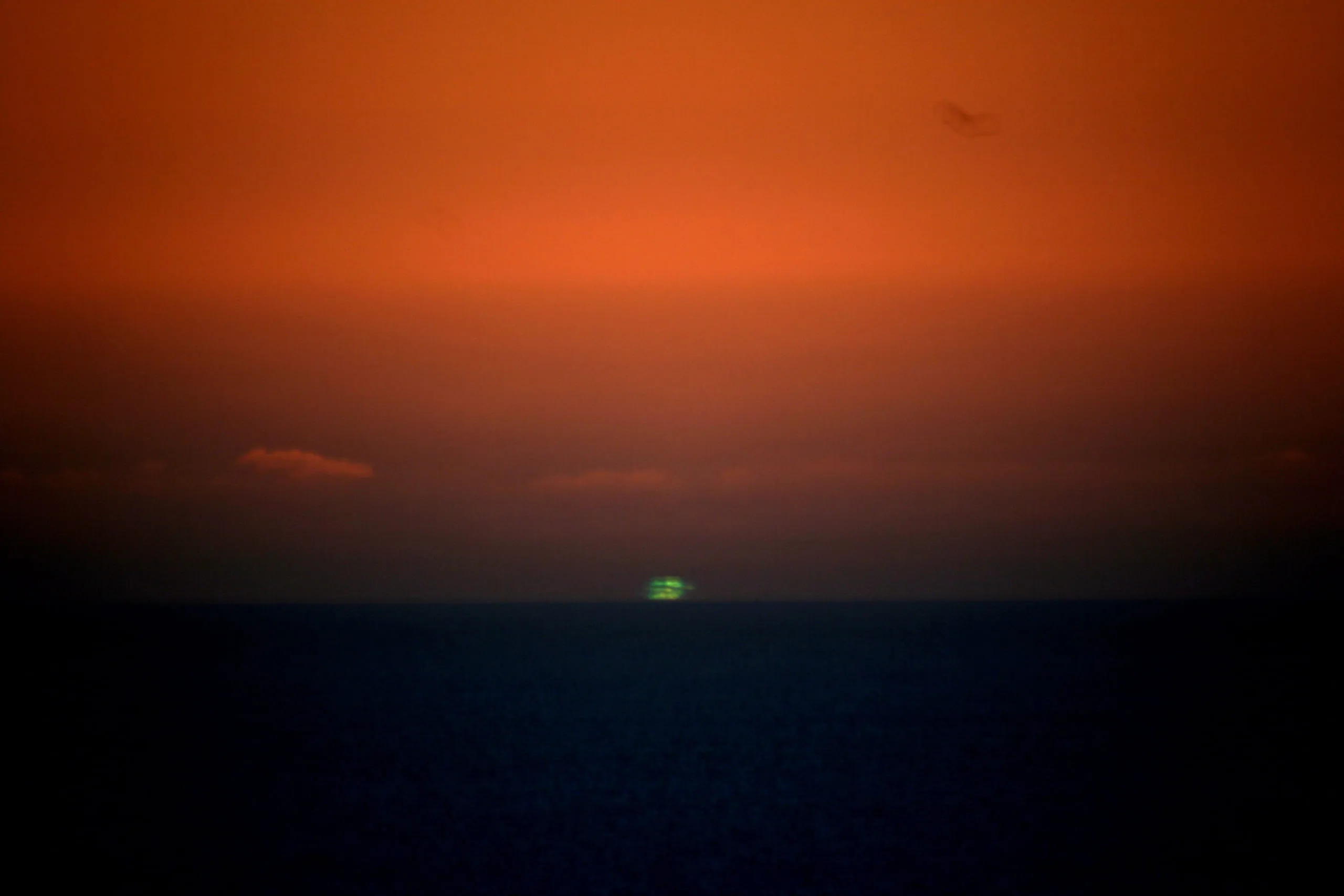
Green Flash

The split-second green at the horizon at sunset

Written by Laurence WayneEntry No. 52Rare

Green Flash: The split-second green at the horizon at sunset
Plate LIIPhotograph by Brocken Inaglory, CC BY-SA 3.0.

A green flash is a brief flash of green light seen at the very top edge of the sun as it sets or rises. The atmosphere refracts sunlight near the horizon, and because it bends shorter wavelengths slightly more than longer ones, the sun's coloured images are stacked — the red sets first, then yellow, green and finally blue, leaving a thin green rim on top. A density gradient near the horizon creates a mirage that magnifies that otherwise tiny green rim into a visible flash.

Worth knowing

  • The flash is green rather than blue or violet because of atmospheric extinction: along the long, grazing path through air near the horizon, the shortest wavelengths are scattered away almost entirely, so green survives as the last colour you actually see.
Note

Still unsure it's the same cloud? Our app, Cloud Point— on iOS and Android — reads a photo and returns the likely type with altitude, useful when a formation is fading faster than you can look it up.
Test yourselfThree levels

Choose a difficulty

When can you see a green flash?

  1. aAt midday with the sun overhead
  2. bAt the moment of sunset or sunrise on a low horizon
  3. cDuring heavy rain
  4. dOnly at the North Pole
Show answer

AnswerAt the moment of sunset or sunrise on a low horizon

It appears at the sun's edge right at sunset or sunrise over a clear, low horizon.

Why does the sun's green image linger a moment after the red has gone?

  1. aGreen light travels faster than red
  2. bThe atmosphere bends shorter wavelengths slightly more, so red sets first and green last
  3. cThe sun emits green light only at sunset
  4. dClouds filter out the red
Show answer

AnswerThe atmosphere bends shorter wavelengths slightly more, so red sets first and green last

Atmospheric dispersion delays the green image relative to the red, leaving a green rim last.

Why is the flash usually green and not blue, and what makes the thin rim visible at all?

  1. aThe sun emits no blue light; clouds reflect the rim into view
  2. bBlue and violet are scattered out along the long horizon path, and a mirage magnifies the surviving green rim
  3. cWater vapour absorbs every colour except green
  4. dThe ozone layer turns the light green and lenses it
Show answer

AnswerBlue and violet are scattered out along the long horizon path, and a mirage magnifies the surviving green rim

Extinction removes blue and violet over the long grazing path, and a near-horizon mirage magnifies the otherwise tiny green rim.

Nearby in the guide