Cloud PointField Guide

Special cloud — roll cloud (volutus)

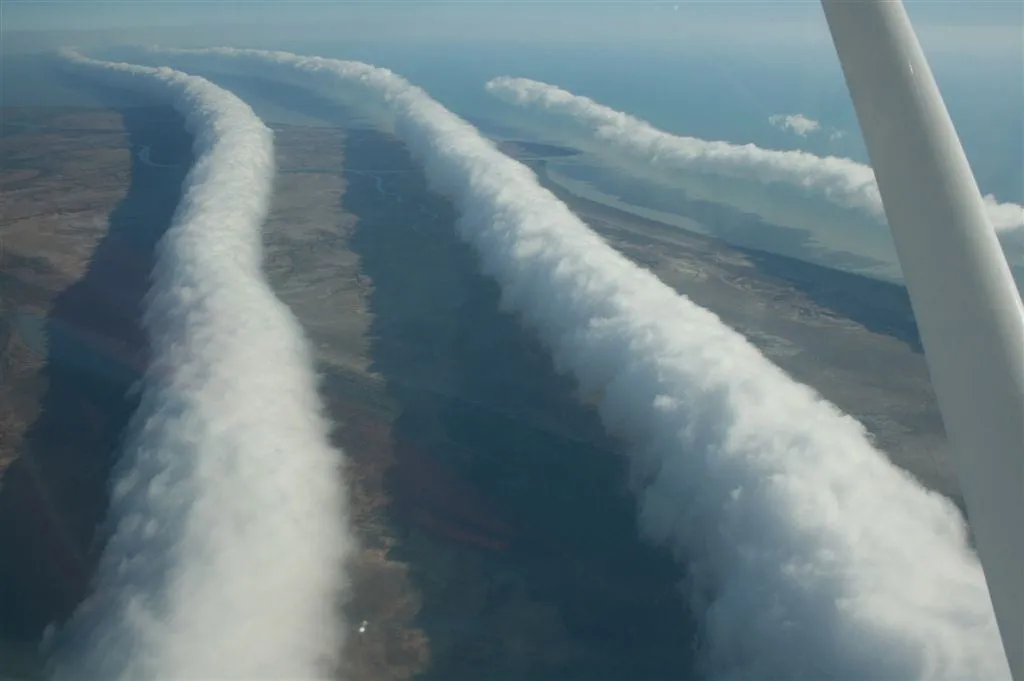
Morning Glory

A 1,000 km tube of cloud glider pilots surf

Written by Laurence WayneEntry No. 5Rare

Morning Glory: A 1,000 km tube of cloud glider pilots surf
Plate VPhotograph by Mick Petroff, CC BY-SA 3.0.

The Morning Glory is a rare and spectacular roll cloud — a vast, smooth tube that can stretch from horizon to horizon, appearing to slowly roll about its own axis as it sweeps across the sky. It forms most reliably over the Gulf of Carpentaria in northern Australia, where glider pilots travel to 'surf' the powerful rising air at its leading edge. Rather than an ordinary convective cloud, it marks the crest of an invisible wave rippling through the atmosphere.

Worth knowing

  • A single Morning Glory roll can be up to about 1,000 km long — roughly the length of Great Britain — and race across the sky at up to 60 km/h, which is why glider pilots gather at Burketown each spring to ride it.
Note

Still unsure it's the same cloud? Our app, Cloud Point— on iOS and Android — reads a photo and returns the likely type with altitude, useful when a formation is fading faster than you can look it up.
Test yourselfThree levels

Choose a difficulty

What does a Morning Glory cloud look like?

  1. aAn enormous smooth tube of cloud stretching across the sky
  2. bA towering cauliflower thundercloud
  3. cA thin coloured ring around the sun
  4. dA patch of glowing cloud at night
Show answer

AnswerAn enormous smooth tube of cloud stretching across the sky

The Morning Glory is a giant, smooth, horizontal roll of cloud that can stretch from one horizon to the other.

A Morning Glory cloud marks the crest of what?

  1. aA jet of volcanic ash
  2. bA travelling wave (a 'solitary wave') moving through the atmosphere
  3. cA spinning tornado laid on its side
  4. dA cold front sweeping inland
Show answer

AnswerA travelling wave (a 'solitary wave') moving through the atmosphere

It is not a normal convective cloud but the visible crest of an atmospheric solitary wave, set off when sea breezes over northern Australia collide and lift moist air.

Why can a Morning Glory roll travel hundreds of kilometres as a single coherent tube, instead of bubbling up and dissipating like an ordinary cloud?

  1. aIt is frozen solid and cannot break apart
  2. bIt rides a self-sustaining wave (a soliton), so cloud forms at the rising crest and clears behind it
  3. cIt is held together by static electricity
  4. dIt is anchored to a mountain range
Show answer

AnswerIt rides a self-sustaining wave (a soliton), so cloud forms at the rising crest and clears behind it

The cloud traces a soliton — a stable, self-reinforcing wave. Air rises and condenses at the advancing crest and sinks and clears behind it, so the tube holds its shape over huge distances.

Nearby in the guide