Cloud PointField Guide

Optical phenomenon — diffraction

Corona

Coloured rings hugging the sun or moon

Written by Laurence WayneEntry No. 7Common

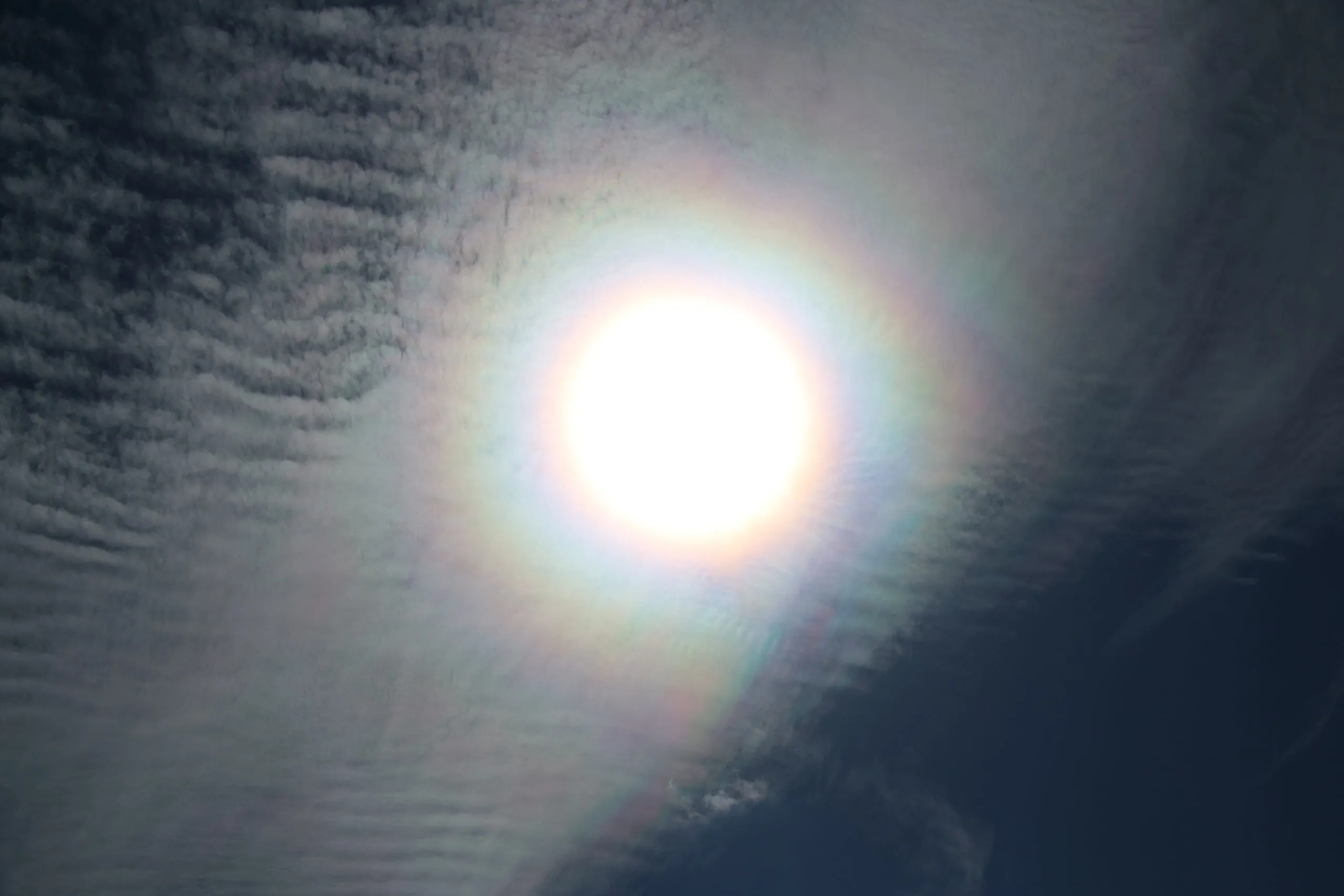
Corona: Coloured rings hugging the sun or moon
Plate VIIPhotograph by GerritR, CC BY-SA 4.0.

A corona is a set of soft, pastel-coloured rings that hug tightly around the sun or moon — much smaller and closer to the light than a 22° halo. It appears when light passes through a thin cloud of very small, uniform water droplets, which bend the waves around their edges so they interfere and separate into colour. The most vivid coronae form in thin altocumulus, and are safest to admire around the moon.

Worth knowing

  • A corona breaks the usual rule that bigger means wider: the smaller the cloud droplets, the larger the rings grow. Coronae can even be cast by airborne pollen — and because pollen grains aren't round, those rings come out slightly oval.
Note

Still unsure it's the same cloud? Our app, Cloud Point— on iOS and Android — reads a photo and returns the likely type with altitude, useful when a formation is fading faster than you can look it up.
Test yourselfThree levels

Choose a difficulty

How does a corona differ in appearance from a 22° halo?

  1. aIts coloured rings hug tightly around the sun or moon, much smaller than a halo
  2. bIt is a huge arc on the opposite side of the sky
  3. cIt is a single white ring set far from the sun
  4. dIt only ever appears at ground level
Show answer

AnswerIts coloured rings hug tightly around the sun or moon, much smaller than a halo

A corona is a small, tight set of pastel rings right up against the sun or moon, whereas a 22° halo is a much larger ring set well away from it.

What process creates a corona?

  1. aRefraction through ice crystals
  2. bDiffraction — light waves bending around tiny water droplets and interfering
  3. cReflection off a flat cloud top
  4. dSunlight passing through falling rain
Show answer

AnswerDiffraction — light waves bending around tiny water droplets and interfering

A corona forms by diffraction: light waves bend around individual small water droplets and interfere, producing the concentric coloured rings.

A corona and a 22° halo can look related, but their physics are opposite. Which statement is correct?

  1. aBoth are caused by refraction through ice
  2. bA corona is diffraction by small water droplets; a halo is refraction through large ice crystals
  3. cA corona is made by ice and a halo by water
  4. dBoth are simply reflections off the cloud surface
Show answer

AnswerA corona is diffraction by small water droplets; a halo is refraction through large ice crystals

A corona is diffraction by tiny water droplets and sits close to the light source; a 22° halo is refraction through hexagonal ice crystals and sits far from it — opposite causes and very different sizes.

Nearby in the guide