Cloud PointField Guide

Supplementary feature — cavum

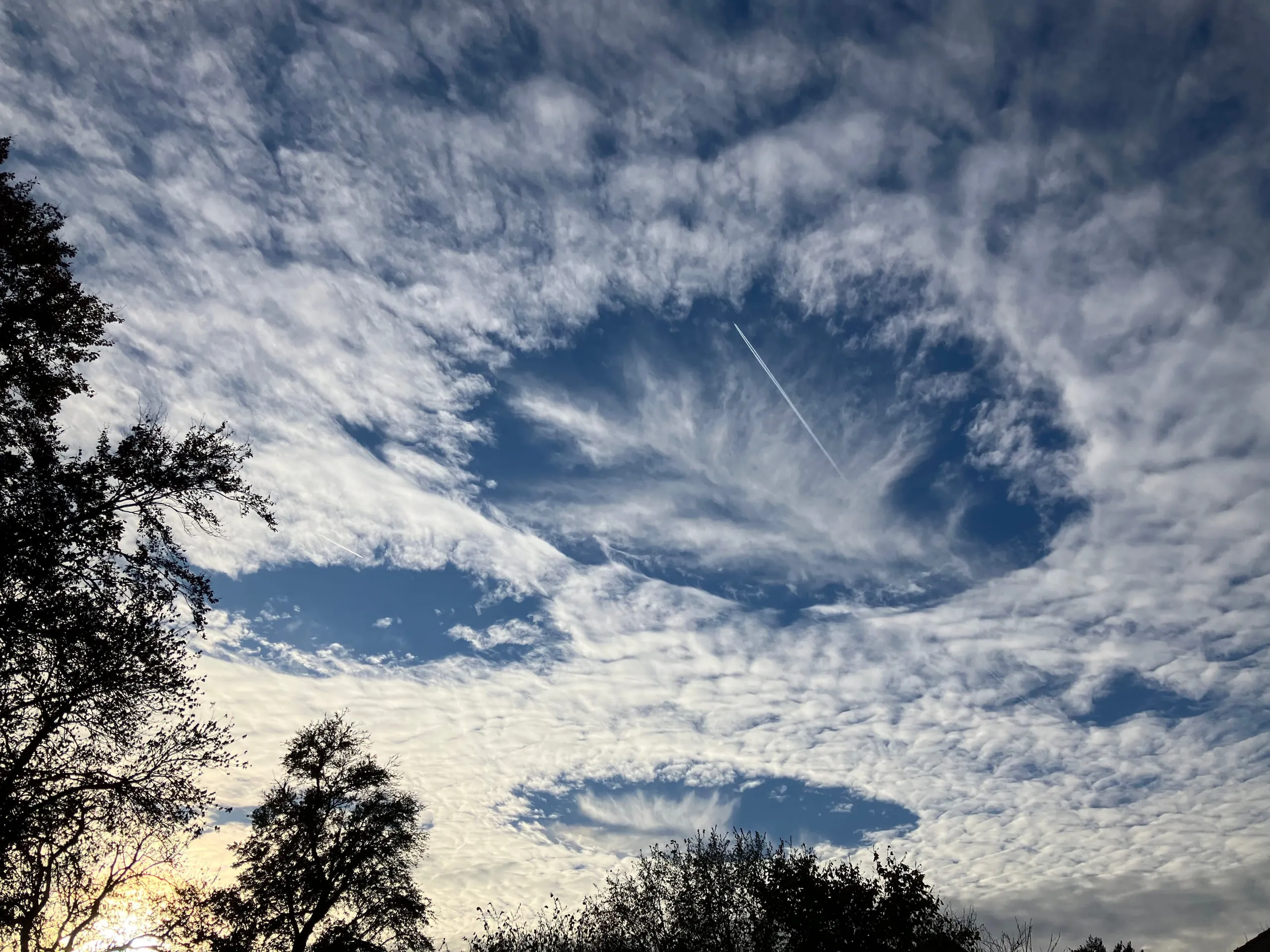
Fallstreak Hole

The hole-punch cloud that sparks UFO reports

Written by Laurence WayneEntry No. 30Uncommon

Fallstreak Hole: The hole-punch cloud that sparks UFO reports
Plate XXXPhotograph by Cherubino, CC BY-SA 4.0.

A fallstreak hole — officially named cavum — is a clean, often circular gap in a thin sheet of supercooled water-droplet cloud. The droplets are below freezing yet still liquid; when something triggers a few to freeze, ice crystals grow at the expense of the surrounding droplets, which evaporate and open a hole. Wisps of falling ice often trail through the gap. Aircraft punching through the layer are a frequent trigger, leaving circular or linear holes.

Worth knowing

  • The WMO formally added cavum to the International Cloud Atlas in 2017 — the atlas's first major update in roughly 30 years — recognising that many of these tidy 'hole-punch' clouds are inadvertently created by aircraft passing through supercooled cloud.
Note

Still unsure it's the same cloud? Our app, Cloud Point— on iOS and Android — reads a photo and returns the likely type with altitude, useful when a formation is fading faster than you can look it up.
Test yourselfThree levels

Choose a difficulty

A fallstreak hole looks like…

  1. aA clean gap punched in a thin cloud layer
  2. bA towering storm tower
  3. cA glowing column of light
  4. dFog sitting over water
Show answer

AnswerA clean gap punched in a thin cloud layer

It is a well-defined hole in a thin cloud sheet, usually with wisps of ice falling through the centre.

The cloud layer that forms a fallstreak hole is made of…

  1. aOrdinary warm raindrops
  2. bSupercooled water droplets — liquid but below freezing
  3. cPure ice from the start
  4. dDust and smoke particles
Show answer

AnswerSupercooled water droplets — liquid but below freezing

The droplets are below 0°C yet remain liquid until something triggers a few of them to freeze.

Once a few droplets freeze, why does a whole hole open up?

  1. aThe ice melts the surrounding cloud
  2. bIce crystals grow while the surrounding supercooled droplets evaporate (the Bergeron process)
  3. cWind simply blows the cloud apart
  4. dSunlight burns a gap through it
Show answer

AnswerIce crystals grow while the surrounding supercooled droplets evaporate (the Bergeron process)

Growing ice crystals draw moisture from nearby supercooled droplets, which evaporate — clearing a hole through the layer.

Nearby in the guide