Cloud PointField Guide

Optical phenomenon — diffraction

Cloud Iridescence

Pastel rainbow colours in thin cloud

Written by Laurence WayneEntry No. 33Common

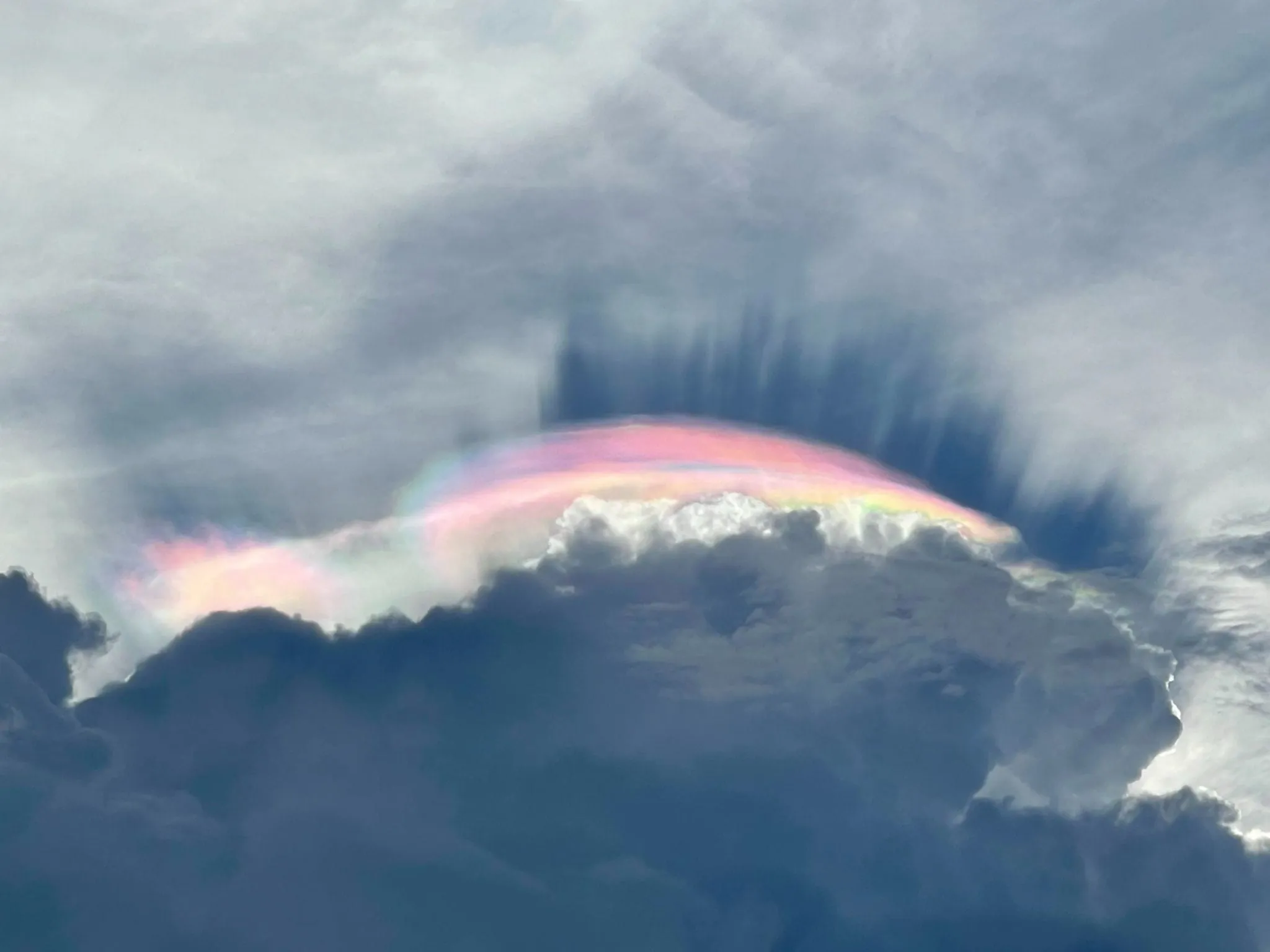
Cloud Iridescence: Pastel rainbow colours in thin cloud
Plate XXXIIIPhotograph by Ericlyons, CC BY-SA 4.0.

Iridescence is the appearance of soft, shifting pastel colours — often greens, pinks and blues — in thin clouds close to the sun. It is a diffraction effect: sunlight bends around tiny, very uniformly-sized water droplets, and different wavelengths bend by different amounts, separating into colours. Where droplet size is patchy the colours scatter into irregular 'mother-of-pearl' bands; where droplets are uniform over a wide area they organise into the neat rings of a corona.

Worth knowing

  • Iridescence is most vivid in newly-formed clouds because their droplets share a common history and are unusually uniform in size — and uniformity is exactly what produces clean colour. A jumble of droplet sizes washes the colours out.
Note

Still unsure it's the same cloud? Our app, Cloud Point— on iOS and Android — reads a photo and returns the likely type with altitude, useful when a formation is fading faster than you can look it up.
Test yourselfThree levels

Choose a difficulty

Cloud iridescence shows up as…

  1. aSoft pastel colours in thin cloud near the sun
  2. bA grey, featureless sheet
  3. cA vertical beam of light
  4. dA funnel hanging beneath a storm
Show answer

AnswerSoft pastel colours in thin cloud near the sun

It appears as delicate, shifting pastel colours in thin clouds close to the sun.

What optical process causes iridescence?

  1. aReflection off icy mirrors
  2. bDiffraction of sunlight by tiny, uniform droplets
  3. cRefraction through raindrops, as in a rainbow
  4. dTotal internal reflection inside hailstones
Show answer

AnswerDiffraction of sunlight by tiny, uniform droplets

Light bends — diffracts — around small, uniform cloud droplets, separating into colours.

Two iridescent clouds show colour bands of different widths. What does a wider colour spacing tell you about the droplets?

  1. aThe cloud is simply closer to the ground
  2. bIts droplets are smaller — diffraction spreads the colours more for smaller droplets
  3. cIts droplets are larger and warmer
  4. dIt contains more ice than water
Show answer

AnswerIts droplets are smaller — diffraction spreads the colours more for smaller droplets

The diffraction angle grows as droplet size shrinks, so smaller, uniform droplets fan the colours out into wider, more widely-spaced bands.

Nearby in the guide