Cloud PointField Guide

Special cloud (upper atmosphere)

Noctilucent

Earth's highest, glowing-at-night clouds

Written by Laurence WayneEntry No. 4Rare

Noctilucent: Earth's highest, glowing-at-night clouds
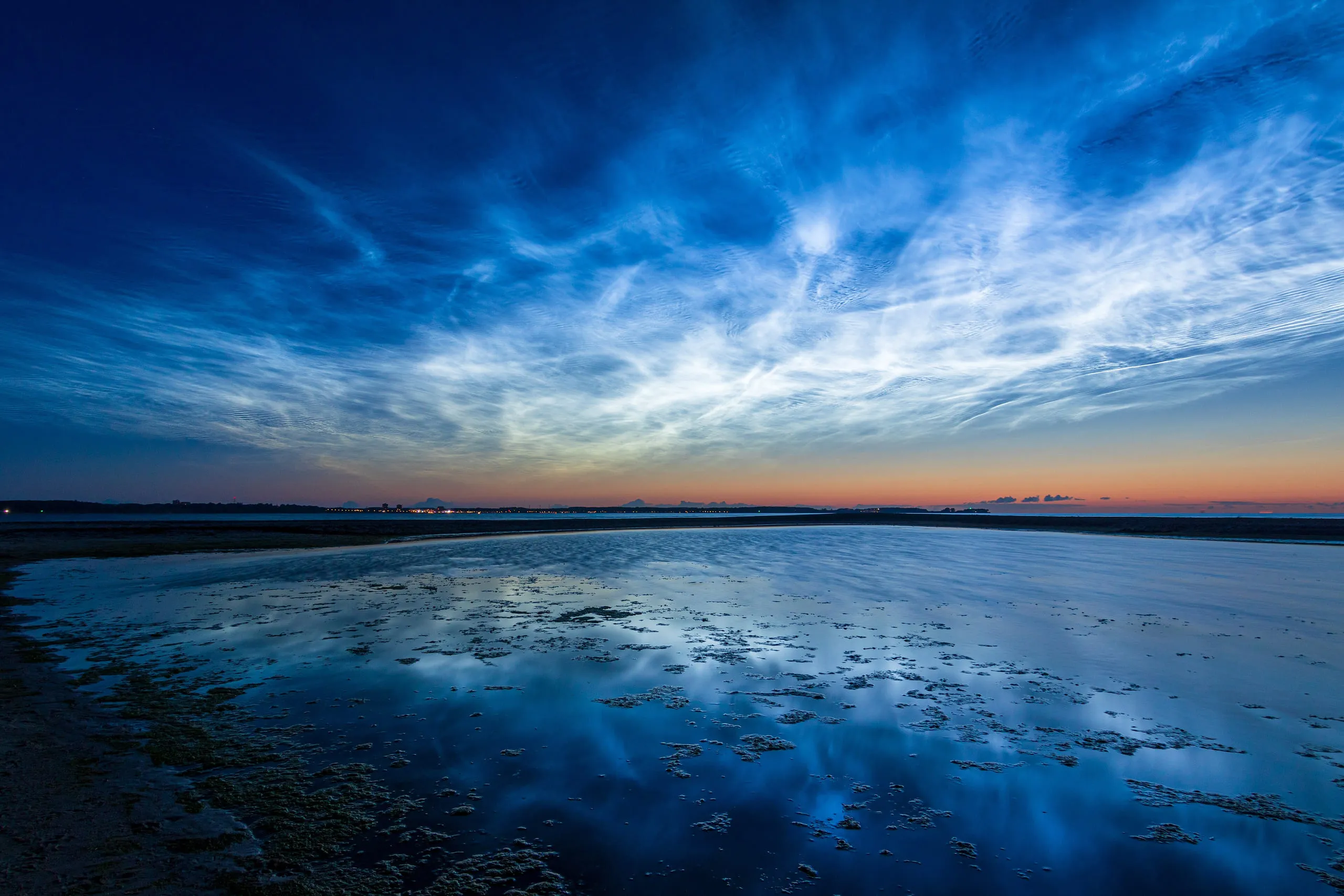
Plate IVPhotograph by Matthias Süßen, CC BY-SA 4.0.

Noctilucent ('night-shining') clouds are wispy, electric-blue clouds seen on summer nights at high latitudes, glowing after the sun has set. They form astonishingly high in the mesosphere — far above all ordinary weather — where tiny ice crystals coat specks of meteor dust. They shine because, although the ground is in darkness, they are still high enough to catch sunlight from below the horizon.

Worth knowing

  • Noctilucent clouds form about 80 km up — roughly ten times higher than a cruising airliner — making them the highest clouds in Earth's atmosphere. They were first reliably recorded in the 1880s, possibly after the eruption of Krakatoa.
Note

Still unsure it's the same cloud? Our app, Cloud Point— on iOS and Android — reads a photo and returns the likely type with altitude, useful when a formation is fading faster than you can look it up.
Test yourselfThree levels

Choose a difficulty

When and where are noctilucent clouds seen?

  1. aOn summer nights at high latitudes, glowing in the twilight
  2. bAt midday over the tropics
  3. cDuring heavy winter snowstorms
  4. dOnly from inside thunderstorms
Show answer

AnswerOn summer nights at high latitudes, glowing in the twilight

These 'night-shining' clouds appear on summer nights at high latitudes (about 50–70°), glowing electric-blue in the twilight after the sun has set.

Why are noctilucent clouds visible at night while the sky below is dark?

  1. aThey produce their own light through a chemical reaction
  2. bThey are so high they still catch sunlight from below the horizon
  3. cThey reflect light from city streetlights
  4. dThey are lit by the aurora
Show answer

AnswerThey are so high they still catch sunlight from below the horizon

At around 80 km altitude these clouds remain in sunlight even after the sun has set for observers on the ground, so they glow against the darkened twilight sky.

Noctilucent clouds form at the summer polar mesopause — the coldest place in the atmosphere. What two ingredients let ice form there?

  1. aVolcanic ash and warm rising air
  2. bMeteoric 'smoke' particles as nuclei, plus the extreme cold (below about -123°C)
  3. cOzone and ultraviolet light
  4. dSea salt lifted from the ocean surface
Show answer

AnswerMeteoric 'smoke' particles as nuclei, plus the extreme cold (below about -123°C)

Ice nucleates on tiny meteoric dust particles only where the summer mesopause plunges below roughly -123°C, around 80 km up — the coldest region of the whole atmosphere.

Nearby in the guide