Cloud PointField Guide

Optical phenomenon — ice crystals

Circumzenithal Arc

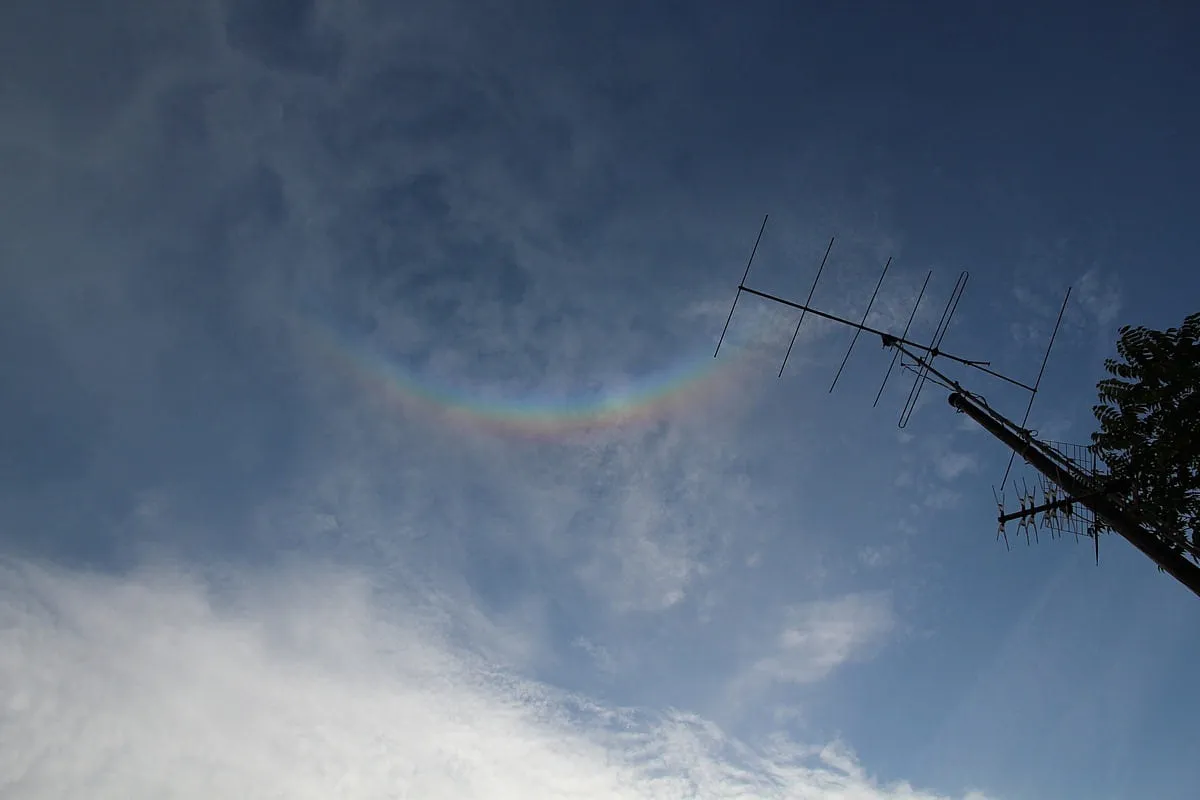
The 'upside-down rainbow' overhead
Written by Laurence WayneEntry No. 42Uncommon

Circumzenithal Arc: The 'upside-down rainbow' overhead
Plate XLIIPhotograph by Uwe Klaunig, CC BY-SA 3.0.

The circumzenithal arc is a brilliant, smile-shaped band of colour that curves around a point near the zenith, high overhead, its bow opening away from the sun. It forms when sunlight enters the flat top face of horizontally-floating hexagonal plate ice crystals and leaves through a side face, refracting through an effective 90° prism. This disperses the light into unusually pure colours, with red on the outer edge and violet on the inner.

Worth knowing

  • The circumzenithal arc switches off when the sun climbs above about 32°: at higher angles the refracted light exits the bottom face of the crystals instead, so the arc cannot form. Its colours are notably purer than a rainbow's because the colour bands overlap far less.
Note

Still unsure it's the same cloud? Our app, Cloud Point— on iOS and Android — reads a photo and returns the likely type with altitude, useful when a formation is fading faster than you can look it up.

Test yourselfThree levels

Choose a difficulty

The circumzenithal arc is nicknamed the…?

  1. aUpside-down rainbow
  2. bSun pillar
  3. cGlory
  4. dGreen flash
Show answer

AnswerUpside-down rainbow

Its smile-shaped bow curving away from the zenith earns it the 'upside-down rainbow' nickname.

What is the circumzenithal arc made by?

  1. aWater droplets, like a rainbow
  2. bRefraction of sunlight through horizontal plate ice crystals
  3. cReflection off snow
  4. dDiffraction by pollen
Show answer

AnswerRefraction of sunlight through horizontal plate ice crystals

Sunlight refracts through hexagonal plate ice crystals — not water drops — to make the arc.

Above roughly what sun elevation can the circumzenithal arc no longer form?

  1. aAbout 32°
  2. bAbout 60°
  3. cAbout 5°
  4. dIt can form at any sun height
Show answer

AnswerAbout 32°

Above about 32° the light exits the crystals' bottom face and the arc cannot form; it is brightest near 22°.

Nearby in the guide