Cloud PointField Guide

Optical phenomenon — ice crystals

22° Halo

The bright ring around sun or moon

Written by Laurence WayneEntry No. 3Common

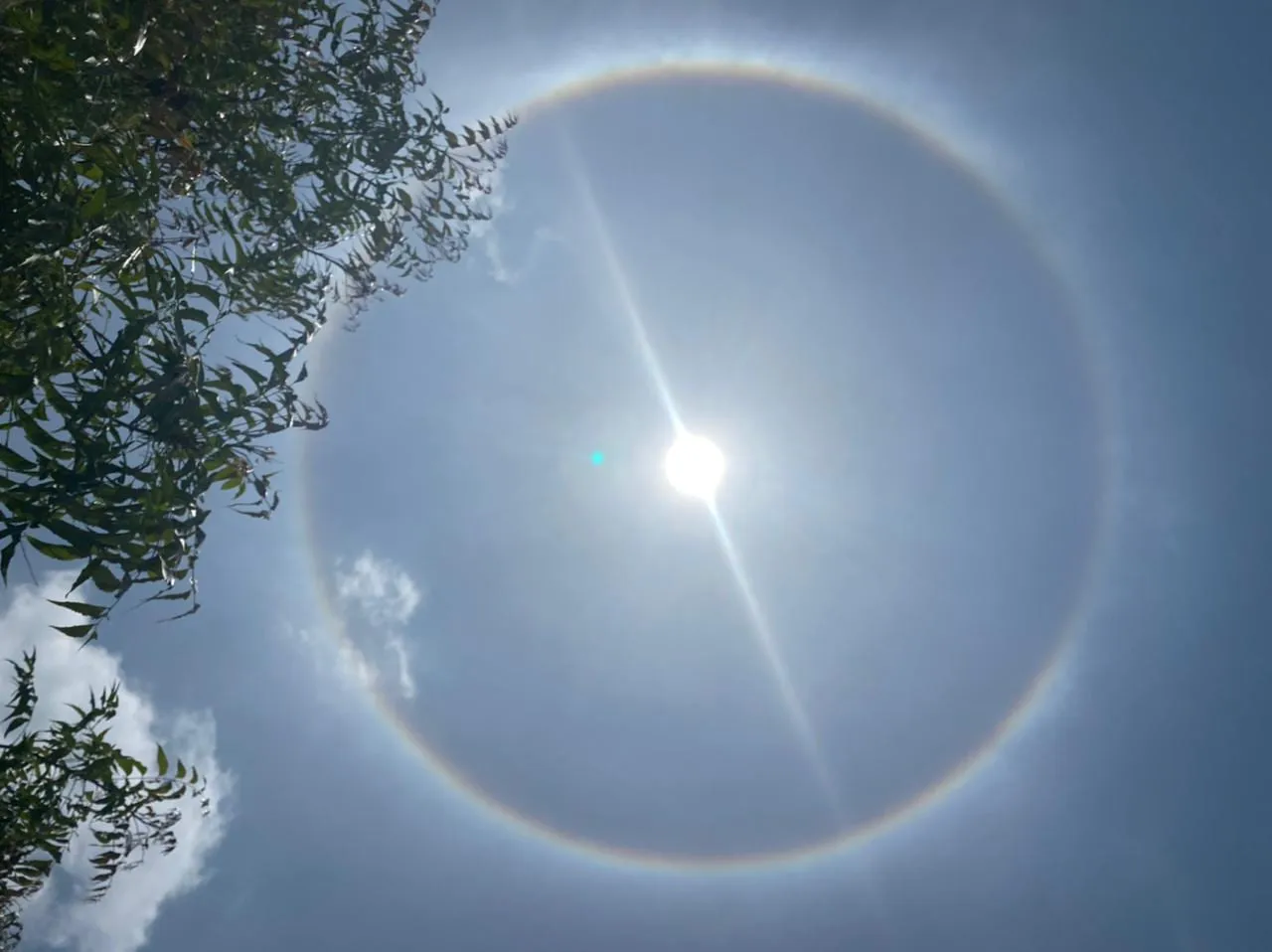
22° Halo: The bright ring around sun or moon
Plate IIIPhotograph by Ansh.prat, CC BY-SA 4.0.

A 22° halo is a luminous ring that encircles the sun or moon at a fixed distance — about the span of an outstretched hand held at arm's length. It appears when a thin veil of high cirrostratus fills the sky with millions of tiny hexagonal ice crystals. Each crystal acts as a six-sided prism, bending the light by just over 22°, so the glow piles up into a ring with a curiously darkened sky inside it.

Worth knowing

  • No matter where on Earth you see it, the ring always sits at the same 22° radius — its size is fixed by the 60° prism angle of hexagonal ice and doesn't depend on how big the crystals are. Look closely and its inner edge is tinged red and its outer edge blue, the opposite way round to a rainbow.
Note

Still unsure it's the same cloud? Our app, Cloud Point— on iOS and Android — reads a photo and returns the likely type with altitude, useful when a formation is fading faster than you can look it up.
Test yourselfThree levels

Choose a difficulty

How would you recognise a 22° halo?

  1. aA glowing ring encircling the sun or moon, with a darker sky inside it
  2. bA multi-coloured arc on the opposite side of the sky from the sun
  3. cA patch of rainbow colour within a single cloud
  4. dA vertical beam of light standing above the sun
Show answer

AnswerA glowing ring encircling the sun or moon, with a darker sky inside it

A 22° halo is a complete ring around the sun or moon, roughly a hand-span in radius, with a noticeably darker sky inside the ring.

What creates the ring of a 22° halo?

  1. aSunlight reflecting off a smooth sheet of cloud
  2. bSunlight refracting through hexagonal ice crystals, which bend it by about 22°
  3. cDust scattering light high in the atmosphere
  4. dWater droplets splitting the light like tiny mirrors
Show answer

AnswerSunlight refracting through hexagonal ice crystals, which bend it by about 22°

Light passes through millions of hexagonal ice crystals, each acting as a 60° prism that deflects it by about 22°, concentrating the glow into a ring at that radius.

Why is the sky noticeably darker inside a 22° halo than just outside the ring?

  1. aThe moon's shadow falls there
  2. bThe ice crystals cannot refract light to angles smaller than about 22°, so almost none reaches the inside
  3. cThe cloud is always thicker in the centre of the ring
  4. dThe halo absorbs the light from the middle
Show answer

AnswerThe ice crystals cannot refract light to angles smaller than about 22°, so almost none reaches the inside

22° is the angle of minimum deviation for the ice prisms — they cannot bend light to a smaller angle, so virtually no refracted light lands inside the ring, leaving the interior dark.

Nearby in the guide